

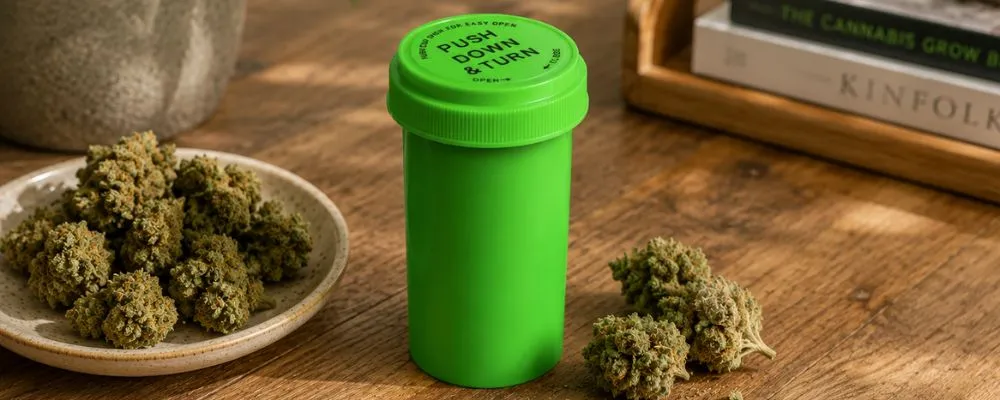
Most cannabis packaging decisions come down to a tradeoff. You can have a container that’s hard for a child to open, or one that’s easy for your customer to open, and the harder you push on one the more you give up on the other.
Reverse cap bottles for cannabis are the packaging industry’s answer to that tradeoff. Instead of picking a side, the cap does both jobs depending on which way you screw it on.
Here’s what they are, how the mechanism works and the situations where they’re the right call.
Table of Contents:
- What are reverse cap bottles for cannabis?
- How the dual-function cap actually works
- Why the reverse cap exists
- The safety case hasn’t gotten weaker
- When reverse cap bottles for cannabis make sense
- Color, light and keeping product fresh
- When a different container fits better
- Sizing reverse cap bottles for cannabis
- Getting your team on the same page
- One cap, two jobs
- Frequently asked questions
What are reverse cap bottles for cannabis?
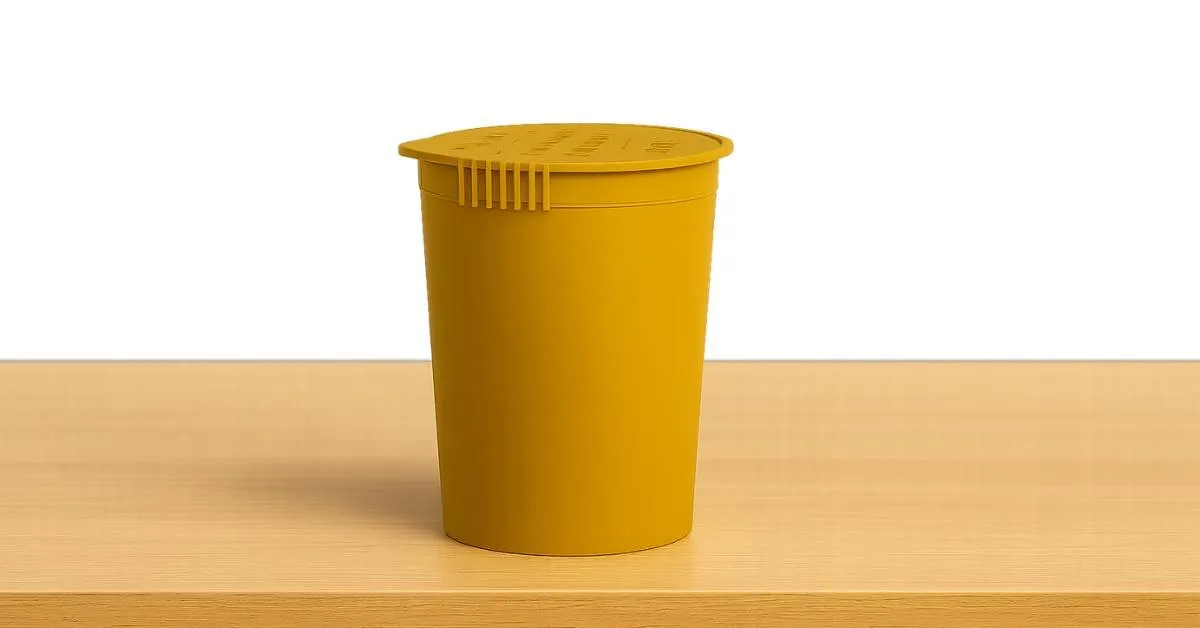
A reverse cap bottle is a container with a two-position lid. Also sold as reversible vials or dual-purpose cap bottles, they look like a standard opaque plastic bottle until you notice the cap has a usable surface on both sides.
Screwed on one way, the cap is child-resistant. Opening it takes a push-down-and-turn motion, the same mechanism most people know from prescription bottles. Screwed on the other way, the cap becomes an ordinary screw top. No downward pressure, no trick, just twist.
Same bottle. Same cap. Two completely different opening experiences, decided at the moment of packing.
Reverse cap bottles come in the standard dram range, typically 8 dram through 60 dram, which covers everything from a single gram to a full ounce depending on density and how tightly the flower is packed.
How the dual-function cap actually works
The mechanism is simpler than it looks. The bottle neck carries a set of lugs, and the cap has matching features on its child-resistant face. In that orientation the two sets engage, and the only way to disengage them is to press down while turning, which is the part young children reliably fail to coordinate.
Flip the cap over and those engaging features point away from the neck. What’s left is a plain threaded closure that behaves like the lid on any jar in the kitchen.
Nothing about that switch is fragile or wears out. The cap does the same job on day 300 that it did on day one, in either position, which is part of why these bottles tend to outlive their original contents in customers’ homes.
Why the reverse cap exists
The dual-function design didn’t come from cannabis. It came from a problem the pharmacy world spent decades wrestling with.
Child-resistant packaging has to clear two bars at once, and they pull in opposite directions. According to the Consumer Product Safety Commission, a package qualifies as child-resistant when at least 85% of tested children can’t open it in the first five minutes and 80% still can’t after ten. But the same package also has to be adult-friendly, meaning at least 90% of tested adults can open it within five minutes.
That second bar got harder in 1995, when CPSC changed the adult test panel to use senior adults aged 50 to 70 rather than younger adults. The reasoning was practical. Packaging that’s too difficult for older adults gets defeated in the real world. People decant products into unsecured containers, or simply leave the cap sitting loose on top. Either way the child protection the package was supposed to deliver evaporates.
The Consumer Healthcare Products Association describes the current senior panel as 100 adults in that age range, each given five minutes to open and properly reclose the package.
So the closure has to be genuinely difficult for a three-year-old and genuinely easy for a 68-year-old with arthritis. That’s a narrow target, and reverse cap bottles for cannabis sidestep it by letting the person packing the product decide which mode the customer receives.
The safety case hasn’t gotten weaker
If anything, the argument for taking the child-resistant side seriously keeps strengthening.
A study published in Pediatrics analyzed National Poison Data System records and found 7,043 reported edible cannabis exposures in children under six between 2017 and 2021. Annual cases climbed from 207 to 3,054 across that span, an increase of 1,375%. Almost all of those exposures, 97.7%, happened in a residential setting.
That last number is the one worth sitting with. This isn’t happening in transit or on the retail floor. It’s happening after the product gets home, which is exactly where your packaging stops being your decision and starts being your customer’s.
It’s the same tension we’ve written about in balancing child-resistant requirements with user experience. Packaging only protects anyone if people keep using it as intended.
When reverse cap bottles for cannabis make sense
A few situations where the dual-function cap earns its place:
Mixed customer bases. If you serve both households with young children and patients who struggle with standard child-resistant closures, one SKU covers both. You’re not forecasting demand across two separate container lines or eating the carrying cost of guessing wrong.
Medical-leaning operations. Patient populations skew older and include people managing dexterity limitations, chronic pain and post-surgical recovery. For those customers a push-and-turn cap is a daily obstacle, not a minor inconvenience. The reversible option removes it without removing the choice.
Repeat-use products. Flower that a customer works through over several weeks gets opened and closed many times. That’s a lot of opportunities for a difficult closure to end up left loose on the counter.
Anywhere the container gets reused. These bottles tend to survive their original contents. Customers keep them for other things, and the cap keeps working in both positions.
Operations that want to simplify inventory. One bottle, one cap, one line item. If you’re currently stocking a child-resistant option and an easy-open option separately, consolidating is a real cost reduction.
Color, light and keeping product fresh
The cap gets the attention, but the bottle around it is doing quiet work too.
Light degrades cannabinoids over time, which is why opaque and translucent colored bottles hold up better than clear ones for anything sitting on a shelf for weeks. Air and heat do their own damage, and a well-seated cap in either orientation limits how much air the product sees between openings.
That matters more than it sounds. We covered the mechanics in how long weed takes to expire, but the short version is that terpenes go first, so a product that smelled loud at packing can taste flat a month later if the container isn’t doing its job.
For long-term storage rather than customer-facing retail, barrier bags outperform any rigid container on oxygen and moisture control. Plenty of operations use both, bulk in barrier, retail units in bottles.
When a different container fits better
Reverse caps aren’t the answer to every flower packaging question.
If your priority is a container that stays child-resistant regardless of what happens after the sale, a standard child-resistant pop top bottle removes the option to switch modes entirely. That’s a limitation in some contexts and exactly the point in others.
If presentation is doing heavy lifting for your brand, glass jars give you a premium shelf presence that plastic won’t match, though at higher cost and shipping weight.
And if you’re moving product out the door rather than storing it, child-resistant exit bags handle that job at a fraction of the per-unit cost.
There’s also a reasonable argument for pairing rather than choosing. Tamper-evident bands work on reverse cap bottles the same way they work on pop tops, and they close the gap between what the cap does and what the customer can verify at the point of purchase.
Sizing reverse cap bottles for cannabis
Dram sizing trips people up more than the cap mechanism does, mostly because a dram measures volume rather than weight, and flower density varies enough that the same bottle holds noticeably different amounts depending on the strain.
The rough working ranges most operators land on:
- 8 dram and 13 dram for a gram
- 20 dram and 30 dram for an eighth
- 40 dram for a quarter
- 60 dram for larger quantities
Our guide to choosing the right dram sizes walks through it in more detail, including how much headroom to leave so you’re not compressing the product to make it fit.
If you’re between two sizes, size up. Compressed flower loses trichomes against the container wall, and a bottle packed to the brim looks less appealing to the person who opens it than one with a little room.
Getting your team on the same page
One practical note that doesn’t come up until you’ve been running these for a while: the cap orientation is a decision someone makes at the packing station, every single time.
That means it needs to be an actual instruction rather than an assumption. Decide what your default is, make sure the people packing know it and decide in advance how requests for the easy-open orientation get handled and noted. A bottle packed in the wrong mode isn’t a defect anyone will catch on inspection, because both modes look correct from the outside.
It’s a small process detail that determines the entire value of the product.
One cap, two jobs
The appeal of reverse cap bottles for cannabis is that they stop forcing a decision you were never well positioned to make. You don’t know which of your customers has a toddler at home and which one has arthritis. The reversible cap means you don’t have to.
Match the size to your product, pick a color that suits your brand and protects what’s inside, then let the cap handle the part that changes household to household.
Take a look at our reverse cap bottles for cannabis and match the size and color to what you’re packing.
Frequently asked questions
Are reverse cap bottles for cannabis child-resistant?
In the child-resistant orientation, yes. The push-and-turn mechanism is the same style used on prescription containers. Flipped to the other orientation the cap is an ordinary screw top and offers no child resistance, which is the intended behavior rather than a defect.
What sizes do reverse cap bottles for cannabis come in?
Typically 8 dram through 60 dram. That range covers a single gram up through an ounce, though exact capacity shifts with flower density and how tightly the product is packed.
Are reverse cap bottles the same as reversible vials?
Yes. Reverse cap bottles, reversible vials and dual-purpose cap bottles all describe the same product. The naming varies by supplier more than the design does.
Can reverse cap bottles be reused?
They hold up well to repeated opening and closing, and customers frequently keep them after the original product is gone. The cap works in both orientations for the life of the bottle.
How do reverse cap bottles compare to pop top bottles?
Pop tops stay child-resistant in every configuration, which is an advantage where you want that behavior locked in. Reverse caps trade that certainty for accessibility, letting the person packing the product decide which experience the customer gets.
Does the bottle color matter?
For anything sitting in storage or on a shelf, yes. Opaque and colored bottles limit light exposure, which slows cannabinoid and terpene degradation. Clear bottles show off the product better but offer less protection over time.