


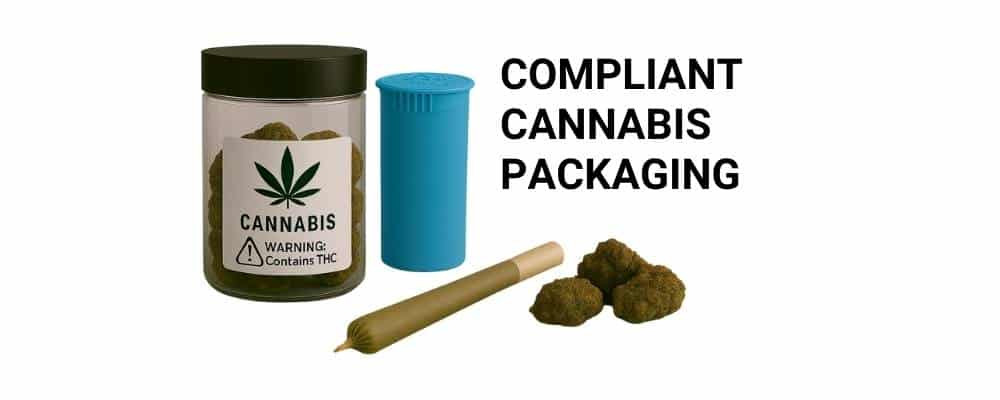
Running a cannabis business means juggling countless regulations. Miss just one, and you could face fines that start at $10,000 and climb to millions. In 2024 alone, U.S. cannabis operators paid over $10.8 million in compliance fines across nearly 2,500 violations.
The packaging sitting on your shelf right now? It might already be out of compliance. That’s why compliant cannabis packaging is critical for protecting your business and avoiding costly mistakes.
Let’s cut through the confusion and look at five packaging mistakes that cost cannabusinesses big money, and how to fix them before regulators come knocking.
1. Not getting child-resistant features right (or forgetting them entirely)
Here’s what trips up even experienced operators: thinking that any secure closure counts as child-resistant. It doesn’t.
The U.S. Consumer Product Safety Commission (CPSC) sets specific standards for what qualifies as child-resistant, and most states reference these standards in their regulations. Your packaging needs to be difficult for children under five to open while remaining accessible for adults.
But here’s where it gets tricky. Each mechanism type serves different purposes:
- Push-and-turn caps work great for bottles and jars
- Grip-n-Pull bags suit flower products
- Pop-top containers handle pre rolls well
The real kicker? Researchers found that all states require delta-9-tetrahydrocannabinol content and manufacturer contact information, but requirements for other specific items showed a random pattern. In New York, regulations allow accurate foreign language translations in addition to the required English labeling, and California requires certain warnings to be provided in Spanish if the packaging or labeling includes Spanish text for other content. A child-resistant mechanism approved in California might fail Massachusetts standards.
Fix it now: Test your packaging with the actual CPSC protocols, not just manufacturer claims. Keep documentation proving your packaging meets federal CR standards; you’ll need it when inspectors ask.
2. Botching the universal cannabis symbol
That little triangle with the marijuana leaf isn’t optional. And no, making it tiny doesn’t count as compliance.
The universal cannabis symbol must be clearly visible on the primary panel of the product’s label, which is the part most likely to be displayed to consumers at retail. States have specific size requirements for this symbol. Warning symbol sizes range from 0.35 inches to over 1 inch depending on your location.
What catches businesses off guard: the symbol placement rules change based on product type. Edibles need different positioning than flower products. Multi-serving products require additional marking on each serving when possible.
The real kicker? Canada maintains different rules entirely, mandating that all mandatory information appear in both English and French. While all states with legal cannabis markets require some form of child-resistant packaging, the specific requirements vary significantly by jurisdiction, with California placing different requirements for different product types and other states having their own unique testing protocols and mechanism approvals.
Fix it now: Measure your symbols with an actual ruler. Check your state’s specific requirements for exact dimensions and placement. Don’t trust your designer’s “it looks about right” approach.
3. Ignoring branding and design restrictions
That cute mascot or playful cartoon on your packaging? It could cost you your license.
States are cracking down hard on packaging designs that could appeal to children. What seems like harmless branding to you looks like youth marketing to regulators, and they’re not taking chances.
Ohio’s rule 3796:3-2-02 explicitly bans “cartoons, imitations of candy packaging, or inclusion of images of actual candy” on cannabis products. Their regulators routinely reject packaging featuring any drawn animals or people, period. No exceptions for “sophisticated” illustrations or “adult-oriented” designs.
But here’s where operators get blindsided: the rules vary wildly by state. California prohibits packaging “attractive to individuals under 21 years of age,” which sounds vague until your strawberry-shaped gummy package gets flagged. Some states allow packaging shaped like animals or food items. Others ban them outright.
The expensive mistake: assuming your approved Colorado packaging design will pass in Ohio. Companies spend thousands on branded packaging only to discover it violates branding restrictions in their expansion states.
Michigan takes a different approach, banning bright colors and images of the product if it resembles candy. Illinois focuses on health warnings rather than design restrictions. Meanwhile, Washington prohibits “images that might appeal to children, including cartoons, toys, or similar images.”
Fix it now: Review every package design against your state’s specific branding restrictions. Search for terms like “appeal to minors,” “cartoons,” and “images” in your state’s regulations. When designing new packaging, default to photography over illustrations, neutral colors over bright primaries, and simple geometric shapes over representational designs. If you’re expanding to new states, get packaging pre-approved before printing thousands of units.
4. Missing track-and-trace integration
This one’s a business killer. Track-and-trace violations account for nearly a quarter of all enforcement actions in states like Washington, with 16% of violations for producers failing to maintain traceability and another 7% for processors and retailers, stemming from issues like inventory mismatches or delayed transfer reports.
You might think your inventory system has you covered. It doesn’t, unless it directly integrates with your state’s tracking system. Every package needs proper tagging from production through sale. One mistyped SKU or package weight triggers violations. This is why compliant cannabis packaging must include accurate labeling and integration with your state’s track-and-trace requirements to avoid costly penalties.
Missouri just updated their requirements, allowing barcodes but requiring them in specific positions relative to track-and-trace numbers. New York has different rules. California has yet another set.
Fix it now: Audit your last month of Metrc entries against physical inventory. Any discrepancies? Fix them immediately. Set up daily reconciliation protocols; not weekly, daily.
5. Failing multi-state compliance standards
Operating in multiple states? Your packaging nightmares just multiplied.
Font minimums fluctuate between 6 and 12 points across different states, forcing many operators to redesign or repackage products for each market. What works in Colorado might get you fined in Illinois. Labels should at minimum contain instructions on how to use the product properly and safely, THC and CBD content of the entire packaged product, THC and CBD amount per serving, and associated health risks.
The expensive mistake: using one package design across all markets. Businesses try to save money with universal packaging. They end up paying more in fines and repackaging costs.
New York regulations mandate that cannabis product packaging cannot be made of plastic unless it contains a minimum 25% post-consumer recycled content. New York’s detailed packaging and labeling framework requires all text to be no smaller than 6-point font size. Each state follows its own unique set of requirements.
Fix it now: Create a compliance matrix for each state you operate in. List every packaging requirement side by side. Update it monthly (regulations change faster than you think).
6. Skipping testing documentation on labels
Your product passed testing. That’s great! But if the test results aren’t properly displayed on your packaging, you’re still non-compliant.
California regulations specify that each cannabis package must include cannabinoid content labeling, including THC and CBD amounts per serving and per package. For nonmanufactured cannabis goods, total THC content must be expressed as a percentage.
The costly error: using old test results or batch numbers. Each harvest, each batch, each product variation needs current testing reflected on its label. Selling untested products or those that fail contaminant standards can trigger record-breaking penalties.
Fix it now: Match every package on your shelf to its test certificate. Can’t find the paperwork? That product can’t be sold. Set up a system where packaging can’t be printed without verified test results.
Your compliance action plan
Stop waiting for violations to find you. Here’s your immediate action checklist:
- Today: Audit 10 random products for all five compliance areas
- This week: Schedule packaging reviews for each state you operate in
- This month: Update your packaging SOPs with current regulations
- Ongoing: Sign up for regulatory updates from each state’s cannabis authority
Remember: Fines can vary depending on the severity of the violation but can reach up to tens of thousands of dollars per infraction. Beyond fines, you’re looking at license suspensions, product seizures and brand damage that takes years to recover from.
Partner with packaging experts who know cannabis
At Green Rush Packaging, we’ve been navigating these regulations since 2017. We work with cannabusinesses across multiple states to keep packaging compliant as requirements evolve.
Compliant packaging for your cannabis products isn’t just about avoiding fines. It protects your license, your brand reputation and your ability to operate. When regulations change overnight, you need packaging partners who understand what’s at stake.
Green Rush Packaging delivers compliant cannabis packaging solutions you can trust. We help cannabusinesses stay ahead of regulatory requirements and protect what matters most: your business. Contact us today!
Shop for compliant packaging now >
Frequently Asked Questions About Compliant Cannabis Packaging
Why is compliant cannabis packaging important?
It helps cannabis businesses avoid costly fines, license suspensions, and product recalls. Proper packaging also protects consumers and ensures transparency in the marketplace.
What are the most common mistakes in cannabis packaging compliance?
Common errors include missing child-resistant features, incorrect universal cannabis symbols, lack of track-and-trace integration, inconsistent multi-state compliance and missing testing documentation.
Does compliant packaging for cannabis differ by state?
Yes. Each state has unique requirements for font size, warning labels, recycled content, and language translations. Multi-state operators need a compliance matrix to manage these differences.
How can I ensure my packaging is compliant?
Work with experienced packaging partners, audit your products regularly, and subscribe to regulatory updates from your state’s cannabis authority.
What happens if my cannabis packaging is not compliant?
Non-compliance can lead to fines ranging from thousands to millions of dollars, product seizures, and even license suspension.